
The Graph Never Went Back to Zero.
Three years of tracking fitness, burnout, recovery, and the slow process of becoming an endurance athlete.

Before we go any further, I should probably explain the graph.
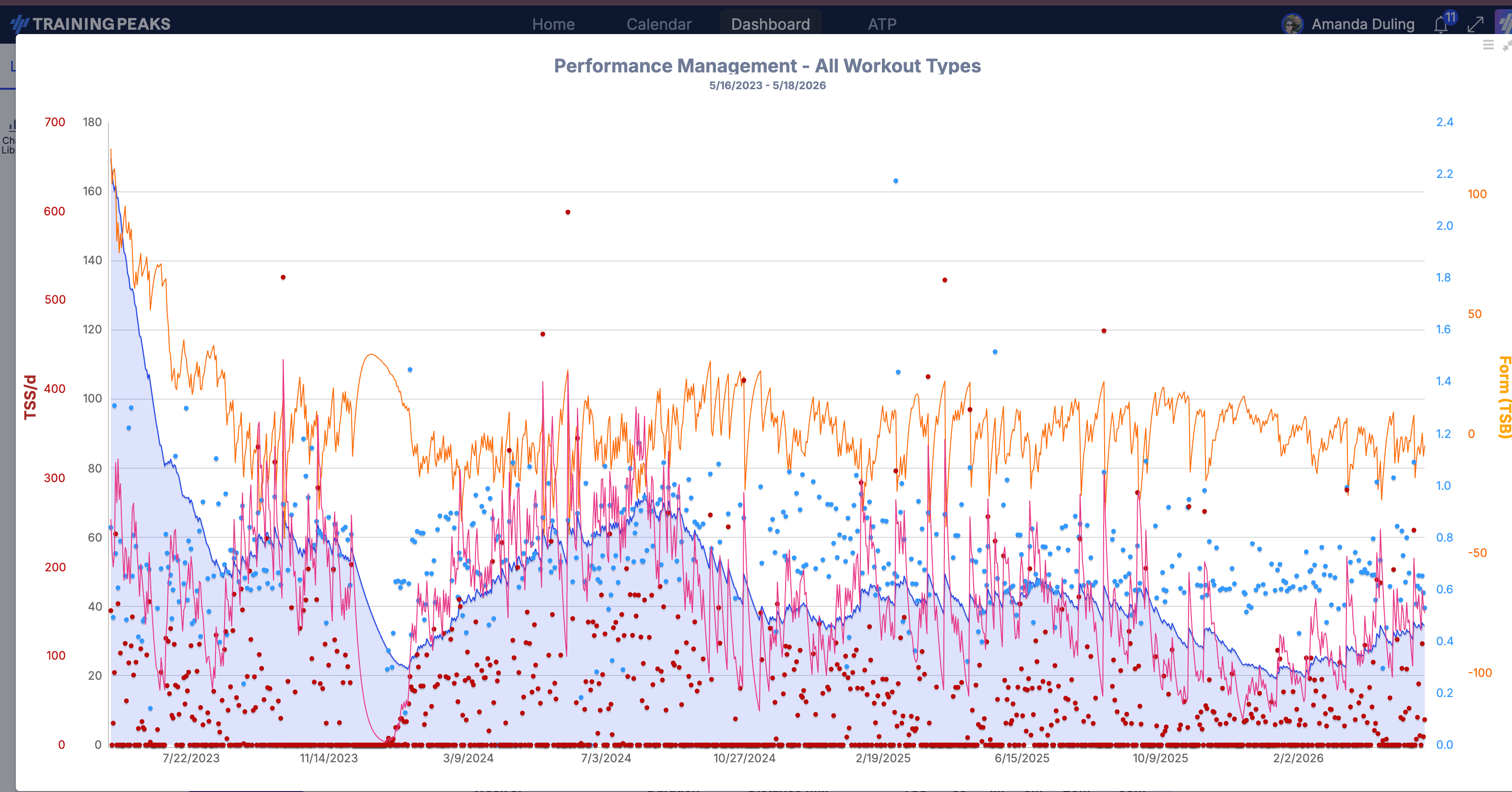
Endurance athletes are weird. We willingly upload our suffering into software and then stare at color-coded fatigue charts like Victorian doctors studying ghosts.
The graph I’m referencing throughout this article comes from years of endurance training data. It tracks three main things:
Fitness (CTL) — a rolling estimate of long-term training load. Think of it as the slow-moving “durability” line. The higher it climbs, the more work your body has consistently absorbed over time.
Fatigue (ATL) — short-term training stress. This moves fast. Big rides, races, hard weeks, poor recovery, and life stress all push it upward quickly.
Form (TSB) — the gap between fitness and fatigue. In simple terms: how cooked you are. Positive numbers usually mean fresher. Deeply negative numbers usually mean you’re carrying a lot of accumulated stress.
That’s the technical explanation.
The emotional explanation is simpler:
the blue line tracked how much work I could absorb
the pink spikes tracked my occasional willingness to emotionally overcook myself
and the yellow line quietly documented whether my nervous system was filing complaints behind the scenes
At first, I thought the chart was measuring workouts.
Three years later, I think it was measuring something much bigger:
whether I kept coming back.
I thought I was tracking fitness.
Turns out I was documenting what it looked like to slowly reorganize my entire life around endurance.
The graph tracked all of it.
The excitement.
The obsession.
The burnout.
The lifting phase.
The recovery I didn’t want to admit I needed.
The periods where I wondered if I even wanted to keep doing this.
And somewhere in the middle of all that chaos, the line stopped going back to zero.
That’s the part I didn’t notice at first.
Not the podiums.
Not the workouts.
Not the spikes.
The floor.
Because every time I backed off, recovered, burned out, changed focus, or drifted a little emotionally away from the sport… the graph still never fully reset.
Apparently this is my personality now.
At First, Everything Works
When I first started training seriously, everything worked.
That’s the dangerous phase.
You ride a little more and suddenly:
your heart rate improves
your endurance improves
your confidence improves
your body starts changing
your brain starts getting addicted to progress
The early part of my chart looks almost reckless in hindsight.
Huge spikes.
Chaotic load.
Aggressive growth.
No real restraint whatsoever.
During early 2024, my fitness line (CTL) started climbing rapidly for the first time. The graph showed repeated high training stress spikes with large swings in fatigue (ATL), often dropping deeply negative before rebounding again.
At the time, it felt exciting.
Looking back now, it mostly looks like a nervous system discovering endurance sports in real time.
The speed of adaptation was emotionally addictive. Fitness was increasing fast enough that almost every hard block initially looked “successful,” which created a dangerous feedback loop between fatigue and validation.
My body responded to endurance training the way Labradors respond to tennis balls. Completely normal and emotionally stable.
The Addiction Nobody Talks About
By mid-2024, the graph showed the first major sustained rise in fitness load.
CTL appeared to climb from roughly the low-20s into the 50–60 range over several months, with repeated large TSS spikes scattered throughout the build.
The problem wasn’t effort.
The problem was that my fatigue line rarely stayed stable for long.
The chart repeatedly showed hard drops in form (TSB), followed by aggressive reloads before the system had fully stabilized.
At the time, I interpreted this as commitment.
In hindsight, it was the beginning of a pattern:
I was becoming very good at accumulating stress, but not yet very good at respecting recovery.
Somewhere during that first major build, I stopped seeing the graph as information and started seeing it as reassurance.
Every upward trend felt emotionally meaningful.
Higher fitness scores felt responsible. Consistency felt morally good. Recovery started feeling suspicious.
The Shape of Burnout
By fall of 2025, the graph changed shape completely.
The curves became larger and more exaggerated — long oval-shaped fatigue waves instead of smaller controlled cycles. The negative fatigue stretches lasted longer. Recovery periods shortened. The system stopped fully resetting between hard blocks.
CTL stayed elevated — roughly in the 60+ range — which meant externally the training still looked productive.
But ATL repeatedly surged far above it, and TSB spent extended stretches heavily negative.
In endurance terms, the system was no longer simply adapting.
It was absorbing sustained recovery debt.
The graph looked impressive.
My nervous system disagreed.
That’s the weird thing about burnout in endurance sports:
you can still function surprisingly well while your nervous system quietly files formal complaints behind the scenes.
I was still training.
Still showing up.
Still building fitness.
But emotionally?
Everything started feeling heavy.
And the hardest part wasn’t even the physical fatigue.
It was realizing I didn’t want to spend every weekend trying to become a hero on a gravel bike while slowly becoming unavailable everywhere else.
I wanted both.
I wanted to be fully present at home—a wife, a mom, a human being my family could actually emotionally access.
And I wanted to be a badass gravel racer.
For a while, I feared those two versions of me couldn’t coexist in the same house.
I didn’t want every thought in my life to involve hydration, recovery, sodium, pace strategy, weather forecasts, carbohydrate timing, or whether my Garmin thought I was “productive.”
One of the clearest signs of burnout in hindsight was that the chart stopped showing clean recovery separations between hard blocks.
The system was carrying fatigue continuously instead of cycling through true reset periods.
And gravel culture doesn’t exactly help.
Endurance sports reward people who can override discomfort. Gravel especially romanticizes suffering.
We glorify:
grinding through exhaustion
huge training blocks
epic conditions
pushing through fatigue
surviving chaos
Which means athletes get very good at mistaking chronic depletion for toughness.
I think a lot of us quietly reach a point where we’re no longer asking:
“Is this healthy?”
We ask:
“Can I survive it?”
And survival becomes the metric.
The Pivot to Heavy Things
Eventually, I hit a point where I didn’t want more endurance.
I wanted lifting.
Heavier things.
Shorter sessions.
Different movement.
Less emotional attachment to constant aerobic output.
Then something subtle but important happened.
The graph softened.
Overall fitness dipped modestly, but the structure became calmer. The giant stress spikes largely disappeared, fatigue stabilized, and the overall wave patterns became noticeably smaller.
At first, that terrified me.
Like many endurance athletes, I associated lower training load with regression.
But looking at the chart now, it’s obvious this period wasn’t collapse.
It was stabilization.
Even during reduced endurance volume, the graph never returned anywhere close to my earlier baseline.
The floor itself had risen.
That’s when I realized I wasn’t starting over anymore.
I was rebuilding from accumulated adaptation.
The reset phase also forced me to confront something endurance athletes rarely say out loud:
eventually, the people you love start experiencing your fatigue too.
Not just your legs.
Your emotional bandwidth.
Your attention.
Your presence.
I didn’t just want to survive training blocks anymore.
I wanted enough energy left over to still fully exist in my own life.
Lifting gave me something endurance had stopped giving me:
freshness.
The fatigue wasn’t a hollow, day-long ache; it was local, sharp, and clean.
The psychological load shifted from enduring hours of monotony to conquering five heavy seconds.
For the first time in a long time, I wasn’t trying to out-suffer myself.
I was just training.
That distinction matters more than people realize.
Especially for women athletes.
Especially for masters athletes.
Especially for people balancing full-time jobs, families, aging physiology, community work, hormones, recovery, stress, and real life outside of sport.
Endurance culture quietly teaches you that more suffering equals more commitment.
But sometimes the smartest thing an athlete can do is back off before the sport takes all the joy with it.
At some point, sustainability becomes more important than heroics.
That was one of the hardest lessons for me to learn.
I thought I was losing fitness.
In reality, I was preserving my ability to stay.
The Current Version Looks Different
The current version of the graph looks dramatically different from earlier years.
The newer training waves are smaller, tighter, and more controlled. The overall structure appears steadier — less emotionally chaotic, less all-or-nothing.
What’s fascinating is that fitness now appears to rebuild with less dramatic stress accumulation than before.
Earlier versions of my training relied on massive spikes to force adaptation.
The newer chart responds more to consistency than destruction.
I think that’s why the newer version of the graph matters so much to me.
It reflects a version of endurance that feels integrated instead of consuming.
I no longer want to build fitness at the expense of the people sitting at my kitchen table.
I want durability big enough to hold all of it:
the racing
the marriage
the parenting
the community
the body
the joy
The question changed.
It stopped being:
“How much suffering can I tolerate?”
And became:
“How long can I realistically keep doing this?”
That’s a much more mature endurance question.
And honestly, probably a healthier one.
Because the truth is:
most people don’t quit endurance sports after one bad workout.
They leave because of accumulated emotional exhaustion.
The training becomes heavy.
The recovery becomes inadequate.
The joy quietly erodes.
And one day they simply drift away.
The Part That Mattered Most
Looking at three years of training data, the most important metric isn’t my highest CTL peak or my hardest ride.
It’s that after every recovery phase, every burnout cycle, every shift in focus, and every period where I emotionally drifted away from the sport…
the graph never fully returned to baseline.
Physiologically, that means accumulated adaptation.
Emotionally, I think it means something else too.
I stayed.
And maybe that’s the real challenge of endurance sports as an adult:
not just staying in the sport,
but staying connected to your actual life while doing it.
Not perfectly.
Not gracefully.
Not without burnout, doubt, fatigue, recovery weeks, emotional overcooking…
or periods where lifting weights felt infinitely better than fighting another brutal Kansas headwind.
But I stayed.
I stayed long enough to learn that endurance wasn’t supposed to consume my entire identity.
I didn’t want to become a weekend hero who was too exhausted to fully exist at home.
I wanted both:
to be fully present in my real life,
and still become the kind of woman who could line up at a gravel race and scare herself a little.
Somewhere along the way, I stopped trying to choose between those versions of myself.
I learned how to build a life durable enough to hold both.
And somewhere along the way, that mattered more than any single workout, race, or fitness peak ever could.
Three years ago, none of this existed.
Not the endurance base.
Not the fatigue management.
Not the recovery awareness.
Not the identity.
Not the version of me capable of staying long enough to become durable.
The graph tracked all of it.
Every spike.
Every rebuild.
Every lesson I learned slightly too late.
And eventually…
it tracked this too.
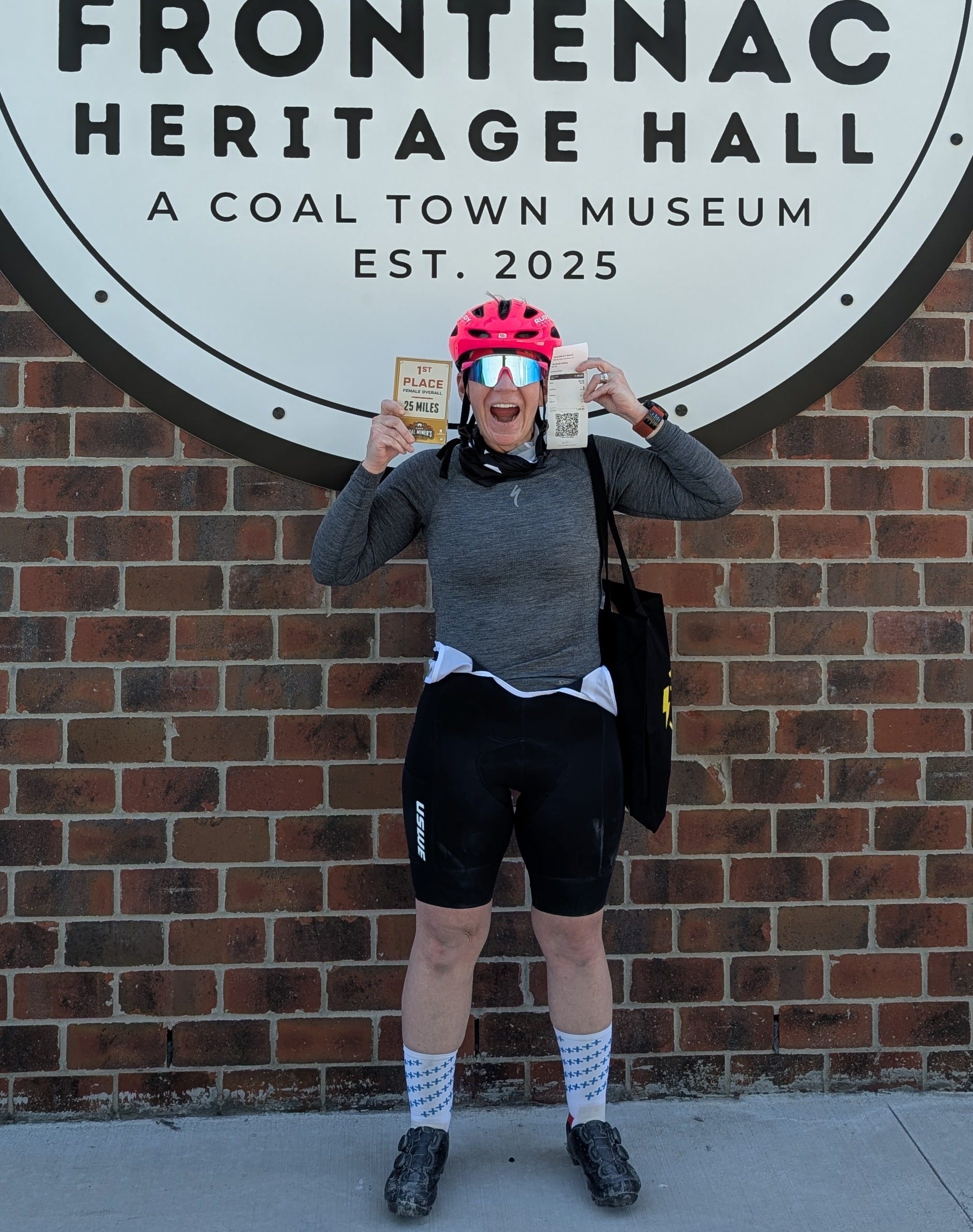
The podium mattered.
But not because it proved I was fast.
Because it proved something far more important:
Staying changed me.
Subscribe
If you didn’t come up through the system—but showed up anyway—this is for you.
I’m building a body of work for athletes learning endurance sports in real time, without the benefit of a traditional on-ramp.
Subscribe if that sounds like your story.
Normal people.
Epic sh*t.
Then the dishwasher.
—Amanda
I publish the thinking here and talk it through on Instagram, Facebook, and TikTok.
Looking for the Books?
Sh*t I Wished People Told Me When I Started Endurance Racing: The On-Ramp Field Guide
Butt Stuff: A No-BS Field Guide to Saddle Comfort, Skin Health, and Not Hating Your Bike
Looking for the Posters?
Don’t Sh*t Your Kit
Bike Shop Etiquette 101
Looking for the Stickers or Other Stupid Sh*t:
DFQ
Fat Bike Love
My Bike Is Dirty Because I Ride It
Support the Armadillos
Endurance sports are full of strange creatures.
Some of them ride gravel bikes.
Some of them wander Kansas at night with armor and zero concern for your tire pressure.
If you want to support the people who rescue injured wildlife — including armadillos — consider supporting Operation Wildlife.
Disclaimer
This content is for informational purposes only and is not intended to diagnose, treat, or provide medical or psychological advice. Always consult with a licensed healthcare or mental health professional before making changes to your training, recovery, or behavioral practices. Amanda Duling is not a licensed medical professional. Participation in any program, guide, or consultation is voluntary and at your own risk.